If you look at this season through the prism of a newly-promoted team from the third tier that has struggled in the Championship for the best part of a decade, then it has been encouraging.
If you look at this season through the prism of a big-spending side with lofty ambitions of Premier League and beyond, with a £3 billion Sports Quarter and stadium project on stream, then it wasn’t what was hoped for.
Somewhere in between, maybe? The lines between expectation and reality have been fuzzy during 2025/26, just like performances veered from one extreme to another.
Blues ended in 10th spot, their highest placing since Gary Rowett’s side in 2015/16.
Nine points from the play-offs . . . imagine, just imagine, if the away form had been even a smidgeon better . . .
Plenty of opprobrium that has cascaded down on manager Chris Davies and his team. Some of it merited, some of it over the top.
A missed opportunity to finish in the top six, and enter the lottery avenue to the top-flight? Sure, especially when it gnaws away in the back of the mind that the Championship is likely to be much stronger next season.
But there has been progress and Blues – as a club, as a team – are far, far from being the basket case they were when bumbling about in the division finishing 19th, 19th, 17th, 20th, 18th, 20th, 17th and then relegated.
Whereas 2024/25 was a memorable, record-breaking, title-winning campaign, awash with smiles in the sunshine and dreams of future glory – you ain’t seen nothing yet, to paraphrase (and clean up) chairman Tom Wagner’s vow at the St. Andrew’s trophy lift – this season was more of the ‘you’re in for a shock’ we were warned about two summers ago for everyone at Blues.
When you add to the mix that the driving force behind it all Wagner had to step back after shock news in February that he had suffered a stroke, the campaign was far from plain sailing.
Yet Blues are in a good place. They are. They are a competitive, competent Championship side with an upside.
They have financial flex as revenues continue to grow, an understanding of what went right and wrong in terms of recruitment and squad composition, a manager who has shown mea culpa – more on that later – and a core group of players who should be better and more knowing next season.
At home, they are as good as anybody. Their performances overall at St. Andrew’s and their record there was promotion-contending standard.
Despite Wagner stating last summer that ‘we would like to be in the Premier League a year from now’, internally at EPIC there was a feeling among the football folk that Blues would probably finish between 10th – 15th, a season of consolidation and growing, and then push on in 2026/27.
Of course, that is not to say Davies et al were defeatist; they aimed for automatic and/or play-offs, but Blues weren’t good enough or consistent enough to fulfil that desire. They were more circumspect in their view, based on historical precedents, about the potential capabilities of a side fresh out of League One whilst also knowing another squad-build was required in the summer – and a lite version, in January, as it transpired.
After Blues kicked-off the season with Friday night football at home to Ipswich Town – a controversial penalty denied them victory, Kyogo looked a livewire – all seemed set fair.
It was a very encouraging performance against a side rated as promotion favourites who seemed a little lost back then and showed Blues plenty of respect.
Unfortunately, successive away defeats at Leicester City and Stoke City either side of the first international break were the start of an underlying trend for performances and results away from St. Andrew’s.
The refrain was familiar: Blues fell behind, conceded poor goals and despite plenty of possession couldn’t conjure up end product.
So often away Blues trailed early and on 16 occasions they went in at half-time behind – the most in the Championship.
Their passivity and lack of physicality was clear. Home teams would often run through them on transitions far too easily.
When Hull City became the first side to win at St. Andrew’s in an astonishing 556 days in somewhat fortunate manner in mid-October, it became clear that Blues Championship journey was not going to be bumpy.
The raised expectation levels and giddy optimism fired by a record-breaking League One title win, 13 summer signings and bullish messaging coming out of the club had become a cross to bear.
It possibly didn’t help that every new addition openly talked about how excited they were about The Project and in effect catapulting Blues to the Premier League – if it were only that simple!
The possession-based style of football that is Davies’ trademark wasn’t as turgid as was often made out. But neither did it, per se, prove suited to a sustained promotion push.
Davies likes control and to get through the lines via recycling and build-up rather than biff ‘n bash.
Successive four-goal salvos as St. Andrew’s against Portsmouth (4-0), Millwall (4-0) and Norwich City (4-1) were joyous, we saw it at its best as the combinations and patterns of play came off, plus there were the first real signs of Marvin Ducksch’s mercurial front play.
Alas, as they continued to splutter on the road, three successive home draws – including against 10-man Derby County on Boxing Day – undermined Blues.
And the abject New Year’s Day defeat at Watford was quite simply embarrassing. Blues were flimsy and hardly shook a leg. They were so easy to score against.
That became a catalyst for change.
Work in the January transfer window was significant. Blues spent around £15 million, with Carlos Vicente, from Alaves, a headline signing.
Jhon Solis was brought in on loan from Girona to address the need for size and power in the middle of the park, Ibrahim Osman from Brighton & Hove Albion to add wildcard pace and August Priske was identified – Lukas Jutkiewicz playing a major role in his recruitment – as a young, mobile striker who could also help alter the style of play.
The 3-2 win over Coventry City three days following on from Watford was a huge result for Davies, whose first January capture Kai Wagner, from Toronto FC, registered a trademark assist with one of his first touches.
That game provided a dolloping hint what was to come as Blues sat deeper than usual, were content to concede possession and went long. They still pressed but chose their moments – they mixed their game up.
The Leeds United FA Cup tie – Blues lost on penalties – was a rip-roaring game and an example of what the team can be like when high octane and also what St. Andrew’s can be like on the big occasion.
After Blues won at in-form Norwich City at the end of February, they moved to within two points of the play-off zone.
But as was the way of things, Blues promptly got biffed 3-0 at Millwall who showed all the basic requirements you need in the Championship: organised, strong, competitive, win individual battles and play at a tempo – rinse and repeat consistently.
Solis was sent-off in the match as he went through the steepest of learning curves, like the other January additions initially.
Defeat at home to Middlesbrough, when James Beadle endured a torrid time amid a flurry of hot potato back passes, and an insipid away loss at Charlton Athletic meant the levels of angst went up a notch once more and Davies again came under fire.
He tried a back five at Derby County and Blues just looked ill at ease and confused. A 1-0 defeat ensued. The mood among the supporters got bleaker.
On Good Friday, coming out of another international break, Blues lost at home to Blackburn Rovers, coming undone after a strong start to the game where they hit the post and should have been ahead.
Striking the woodwork, incidentally, was a peculiar and frustrating habit all season – 27 times Blues did it, a league high.
By the end of the Rovers game, Blues looked like they were lacking in self-belief and conviction.
Undoubtedly, teams had worked out the best ways to play against Blues and nullify them as the season progressed, by primarily getting after the deep midfielders, blocking up the middle and forcing them out wide confident they could deal with crosses into the area.
Blues made more crosses than anyone in the Championship. Whilst that might look good on paper, the reality is crosses are often a last resort because much else has broken down.
With Blues the away side, opponents quickly realised they struggled on defending fast transitions, and staged few attacking ones of their own, and too often lacked penetration and punch in the final third, as well as physical oomph.
On Easter Monday there was a significant shift.
Vicente started at Ipswich Town (and scored). Priske and Jay Stansfield led from the front. Phil Neumann returned – the stats showed when he and Christoph Klarer were at the back, the results were better – and Solis was in favour again, too.
Although Blues lost – and had an equaliser wrongly ruled out by an assistant referee deciding Osman crossed a ball from behind the byline – they played well.
Wagner’s return from injury then helped, too, and as Blues played forward a lot quicker – to Priske, Osman and Vicente – got runners beyond and behind, they looked a different proposition and more Championship effective.
The tweak in style comfortably dealt with Wrexham and back-to-back 2-1 home defeats of Preston North End and Bristol City – albeit in dead rubbers – enabled Blues to finish the season with a little flourish and in positive manner.
Had Osman been less wasteful at Fratton Park, Blues would have rounded it off with victory at Portsmouth. Here, in a nutshell, was another reason for the rank road record – often when Blues had big moments or big chances, they didn’t take them. They were not ruthless enough.
Away from home Blues scored just 18 times. Only Sheffield Wednesday and Stoke City had worse goals return on the road.
Blues ranked in the bottom four for the kind of direct attacks we eventually began to see, which is something that must be developed and enhanced next season.
Davies had the players at his disposal for quick raids. But the more methodical mindset from last season seemingly couldn’t be expunged, until late on.
When Blues did dash and execute them, they carved out major openings. But it didn’t happen anywhere near enough, over the course of the campaign. Only Sheffield Wednesday were ranked lower for fast breaks.
Much has been made of Blues statistical-based recruitment model.
It is hugely encouraging that the club has gone down this route and have invested considerably in such an important aspect of modern football. They have gone from a scattergun, mates’ rates approach to buying a company that supplied the likes of Real Madrid and Chelsea to create their own bespoke modelling and create a huge database.
None of us know exactly what goes on at EPIC in this regard and how the numbers and data are interpreted. And it is fair to say that recruitment is not an exact science – it’s unheard of for every single signing a club makes to come off. People such as myself and supporters analysing the ins and outs have the benefit of hindsight, too.
There have been some good signings, encouraging captures and some duds. Plus, a huge turnover of players ever since relegation.
How aligned recruitment has been to team stylistic needs and Championship requirements, and/or whether it’s a case of a manager simply not fancying a player once he works with him or using what he has more productively, is open to conjecture, judging by the fact we saw shifting sands between summer and winter transfer windows.
Take the oddity of Kanya Fujimoto, for example. Presumably signed to play in the 10 role, he hardly figured. Whereas the data might have flagged him as a potential influencer, was a slight player producing good numbers in the weaker Portuguese league really going to be a good fit for the robust Championship, where he has never played and is a league like no other?
Marvin Ducksch is a German international. By his own admission, he wondered whether he would be suitable for the Championship and once into the season talked about being marked by ‘two oxon’ every game. Ducksch has contributed, but what he has given, he has taken away, too. Blues had to concede mobility and running power, their pressing power, and he’s not a target man, either. The knock-on effect saw Stansfield moved between the nine and 10, and sometimes wide.
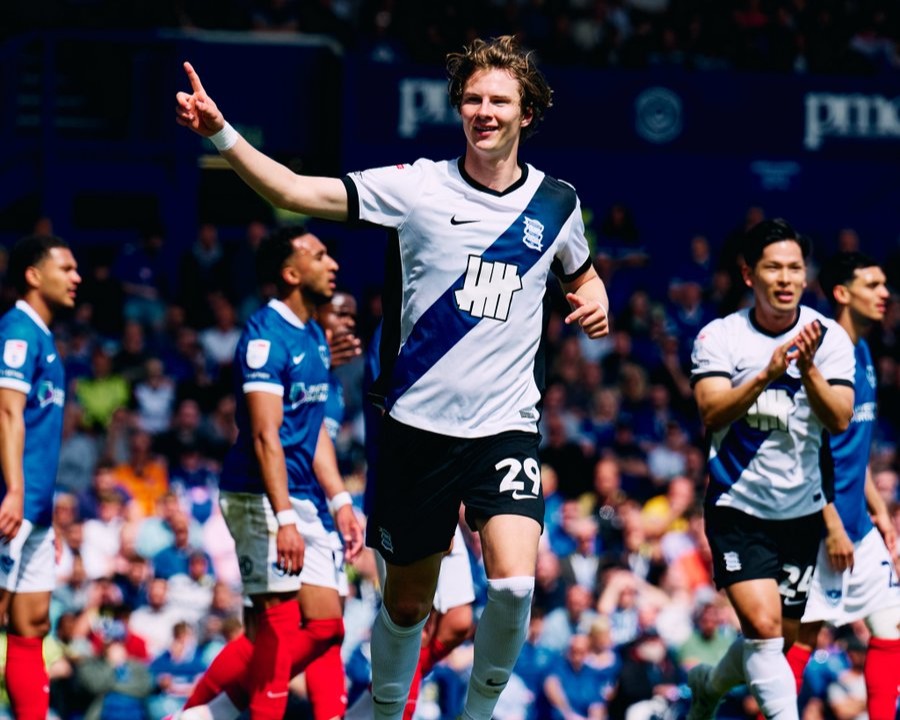
There is also a conversation that could be had over Priske. Despite his size, he is not your typical number nine focal point in the mould of a Jutkiewicz. His game in Sweden was not about winning aerial duels and getting the ball into him to stick, which he was asked to do by Blues. He was more of a penalty box finisher, making good runs to get on the end of things.
In January, the addition of Wagner, Solis, Osman, Vicente and Priske were requisite. They were successes, and a signpost to what’s ahead next season.
The jettisoning of the likes of Lyndon Dykes, Keshi Anderson, Willum Willumsson and Alfons Sampsted whilst sending loanees Eiran Cashin and Lewis Koumas back to their parent clubs was ruthless and decisive.
There is a fair argument that the team should have had more of a core of oven-ready Championship players from the off, that vital know-how of the league, as well as athleticism and physicality.
Many Blues players have not played in the Championship before, or don’t have a depth of experience in the division, and those that are retained will, hopefully, have learned much so that they are all the better for it next season.
Wrexham – the team Blues finished well clear of last season in League Two – went down this route and spent a record £33 million in the summer transfer window. They finished above Blues and were squeezed out of the play-offs on the last day. But were they so much better than Blues, really?
It’s a fine balancing act of assembling the right kind of team and squad in the second tier. And it can take time and patience. Coventry City finished 16th and 12th in their first two seasons in the Championship after winning League One in 2019/20, then there were two play-off heartaches – in both the final and semi-final.
Davies had not managed at this level before. This was only his second season as the number one.
Knighthead and Wagner selected him to lead the new Blues for a reason and surely the powers that be realised he was going to have raw edges. He learned, experimented and kind of felt his way as he went along, and he had nobody of sage experience of the league to lean on around him, either.
His interviews prior to the last game at Portsmouth were fascinating. At his pre-game press conference, he admitted to various things, including that he found it a surprise the league was not as technical as he thought it would be, resulting in an eventual sacrificing of some of his core principles at the turn of the year.
The away form was not skirted over, and he pinpointed a lack of real potency in terms of being clinical and goal power. It was clear, from the way Davies talked about a range of topics, that there was a recognition of major alterations required and that he wanted to, and intended to, implement them.
When the dust settles a little and once the owners have had their season debrief, we should have more clarity on the way ahead and whether it’s with Davies or not, who has just become the first Blues boss to start and complete two successive seasons since Lee Clark 12 years ago.