In the second part of our special feature, Martin Grainger discusses the crowning moment of his Blues career – and then how it all went sour at St. Andrew’s.
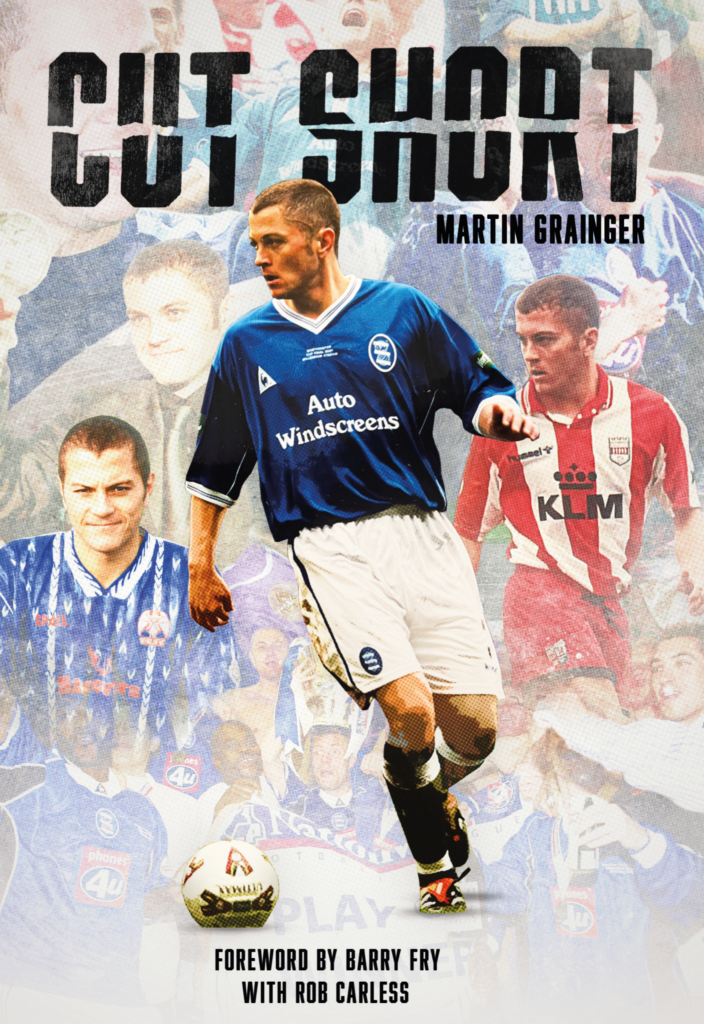
The left-back spoke to Forever Blues to coincide with the launch of his book, Cut Short, which charts his colourful career including a lenghty spell at the club where he became one of the most popular players of the modern era.
Cut Short can be purchased here via Curtis Sport; the first part of our interview can be read here.
Cardiff. The Millennium Stadium. The 2001/02 Championship play-off final. The richest game in club football.
To the winner, it was estimated to be worth around £40 million – then a huge amount – due the land of milk and honey that was the Premier League.
Blues had been knocking on the door for three seasons in a row, losing each time at the last hurdle, including twice on penalties.
Martin Grainger had lived and felt that pain. The left-back, an important part of the team for Trevor Francis and then Steve Bruce, had also missed out with Brentford in the semi-final, in 1994/95.
So this time, surely, it was going to be different?
As seemed to be the case during Grainger’s nine-year career at St. Andrew’s, nothing was straight forward.
A tense showdown against Norwich City went into extra-time, neither team scoring.
Yet barely sixty seconds into the first period, he didn’t cut out a crossfield pass. Alex Notman centred and Iwan Roberts headed the Canaries in front. It was an uncharacteristic lapse.
“That was a harder game to play in than the Worthington Cup Final,” says Grainger, who had the first Blues penalty saved in that shoot-out defeat by Liverpool, in the same stadium, 15 months earlier.
“There was so much at stake.
“I’m looking at the ball, where I’m going to control it, and it goes under my foot, out wide. They cross it to score . . . no, not me again.
“Thankfully Horse got us out of trouble and Darren Carter made his name.
“To win it, to go up after all those previous attempts, it was an incredible feeling. It was draining as well. There was such pressure on that game.”
Geoff Horsfield stooped to head Blues equaliser in the 102nd minute and yet another huge match came down to penalties.
On this occasion Blues – who had lost their previous six shoot-outs – came good, with 18-year-old local lad Carter sweeping in the clinching spot-kick (4-2).
Grainger recalls: “People always say to me ‘ah you didn’t take one because you missed a penalty in the cup final’.
“But I had actually turned my ankle in the game, towards the end. My right foot was quite swollen.
“I said to Brucie ‘look I don’t feel confident in planting my right foot’. I didn’t want it being an excuse if things went badly and having people go ‘well, you shouldn’t have taken one then’.
“I took the decision away from anyone but myself. Otherwise, I would have taken one.”
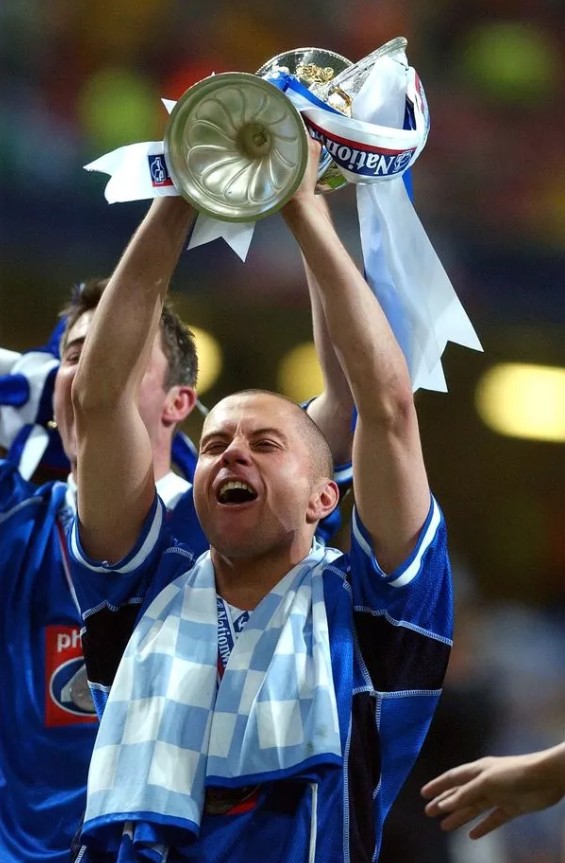
Grainger felt immense pride at creating Blues history. A return to top-flight football after a 16-year absence.
But it didn’t go as he would have hoped, due to the familiar refrain of serious injuries.
He played nine times in 2002/03 and, eventfully, had to retire in December, 2004.
It was real eye-opener, the first match, against Arsenal at Highbury.
“I was probably in the top three or four fittest at the football club and I was blowing after 70 minutes.
“I always used to watch the Premier League with my dad and say ‘I could play here, you get so much time on the ball’.
“But when you have got Patrick Vieira closing you down . . . it’s completely different.
“Going up as a new club as well, and you haven’t quite got the quality, it is very difficult chasing the ball for an hour.”
Grainger had been denied a move to Blackburn Rovers two summers previously when Blues priced him out.
Bruce wanted to do right by him.
“Brucie spoke to me and said he knew the Blackburn thing didn’t happen, and what it might have meant to me and my family. He said let’s see where you are after six games, and do that Premier League (new) contract.
“In the seventh game I did my patella tendon, at Middlesbrough, away.”
Under Bruce, and an evolving side including the inspiration of Christophe Dugarry from that first January, Blues gained a foothold until their fourth successive season among the elite ended in relegation.
Grainger had played little part. “I went to Coventry City on loan (in February, 2004), came back, but I wasn’t able to do what I wanted physically.”
He scored on what would be his last appearance as a professional, a free-kick against Manchester United in April, 2004.
“I came on after about 17 minutes for Stan Lazaridis. There was free-kick earlier, which I took, when I heard this crunch and my patella tendon ruptured. The shot hit the shins in the wall.
“We got another free-kick and Brucie said ‘take it’, I said ‘I can’t!’. I did, it went in, and I didn’t come out after half-time because I’d done my knee again. That was it – all over.”
In the book Cut Short, Grainger is heavily critical of the way the owners of the club, David Sullivan, the Gold brothers and Karren Brady, treated him through this period.
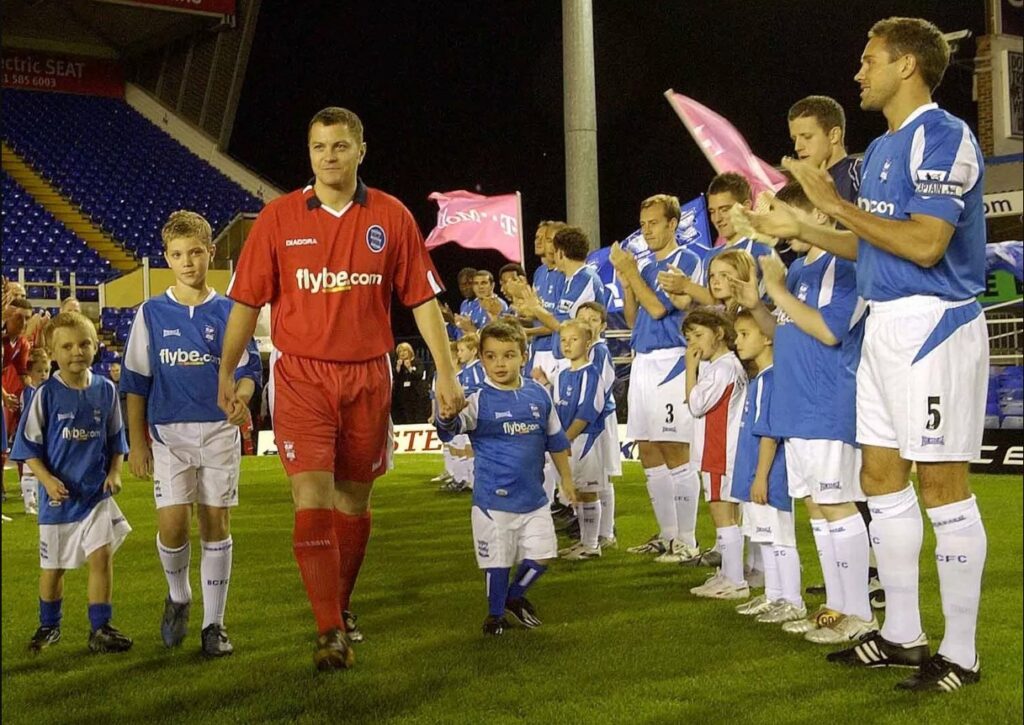
He was told he could have a testimonial, but had to organise it himself. It was eventually staged on a cold night in November, with Blues second from bottom in the league, and around 4,500 came out to watch a match between the first team and a Martin Grainger XI.
Negotiations about a settlement on his contract he described as ‘hardball’, and a proposed coaching job in the Academy was offered – on a salary of £11,000-a-year.
“After giving nine, 10 years to the club and helping them as a part of a team to get to the Premier League, making them millions of pounds, I felt like I was rolled up in a ball and booted out.”
Grainger moved back to his native Hertfordshire and became a train driver. It took him five years to step foot in St. Andrew’s again due to the sour taste left at the end.
He was one of Blues foremost and most well regarded players of modern times. He was voted into the club’s 150th Anniversary Best Ever XI.
He played in a variety of positions for Blues, not just at left-back. He was an accomplished central midfielder or left-side midfielder, who had excellent ball striking ability at set-pieces and free-kicks.
Asked to describe himself, he responds ‘just a decent all rounder who lacked a bit of pace’.
“I felt I was good enough to play there (in the Premier League) for a long period of time. Pace wise, I wasn’t quite there but I used to get myself into positions where I could counter act that.
“But we’ll never know, because of the injuries. I should have played a lot more game for Blues. But they weren’t ‘silly’ injuries, they were big ones.”
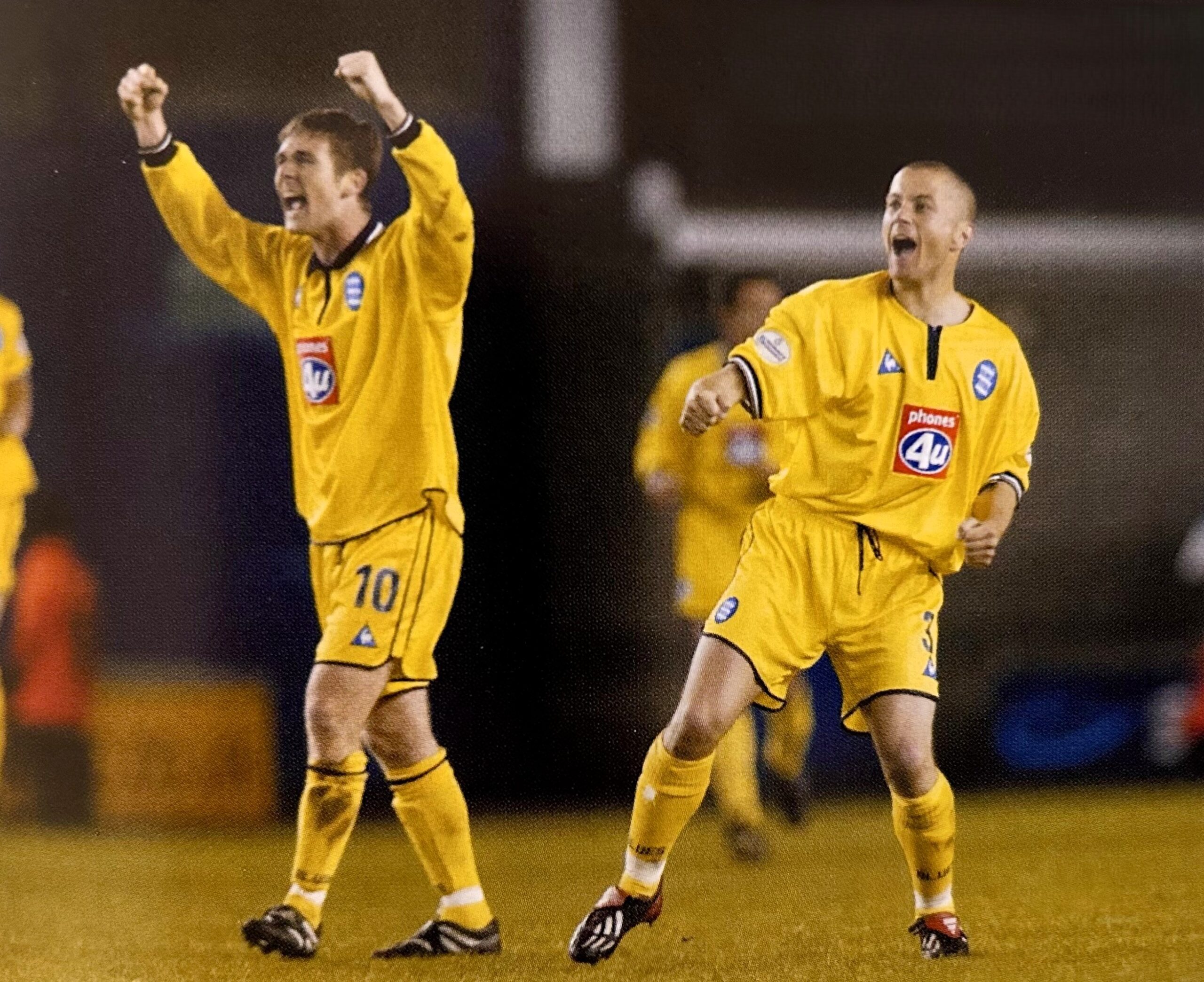
Highlights for Grainger? “The Ipswich Town (Worthington Cup semi-final), best memory ever.
“The two cup finals and being accepted by the supporters as one of their own. I think they liked me because I was normal. one of them. I’d go to the TF lounge after the game, where my family, friends and fans were, rather than the players’ lounge.”