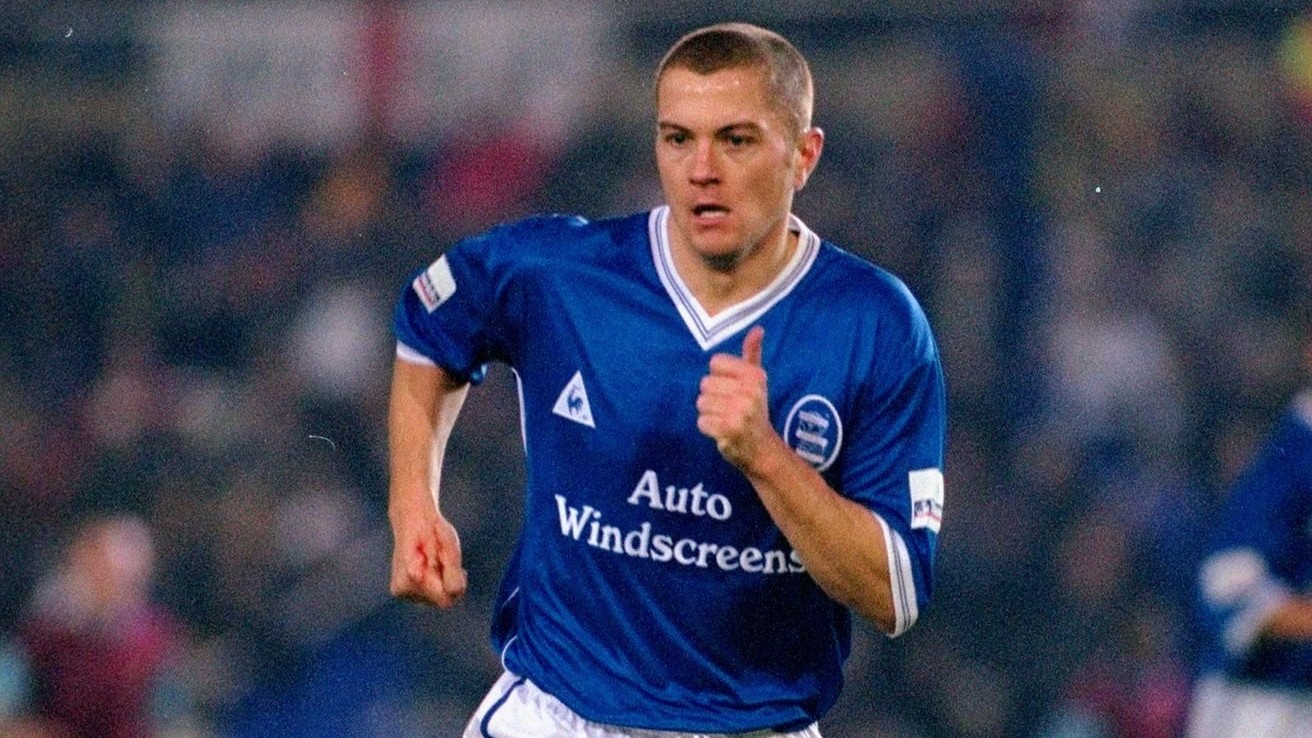
He was one of the most popular Blues players of the late 1990s to the mid-2000s.
A tough-tackling left-back, Martin Grainger spent nine years at Blues, totting up 266 appearances and scoring 28 goals. Had it not been for serious injuries, he would have figured many, many more times.
Grainger – Barry Fry’s penultimate signing, at £400,000 from Brentford – had to retire at the age of 32, due to a knee issue.
He reached two major finals with Blues – helping to clinch promotion to the Premier League after a 16-year top-flight absence – and was a losing play-off semi-finalist three times. Grainger was the club’s player of the season in 1999/2000 and named by his peers in the PFA team of the season.
For the past decade Grainger has been a train driver, and is enjoying life again after his relationship with Blues soured for several years due to the way his exit was dealt with by the then hierarchy.
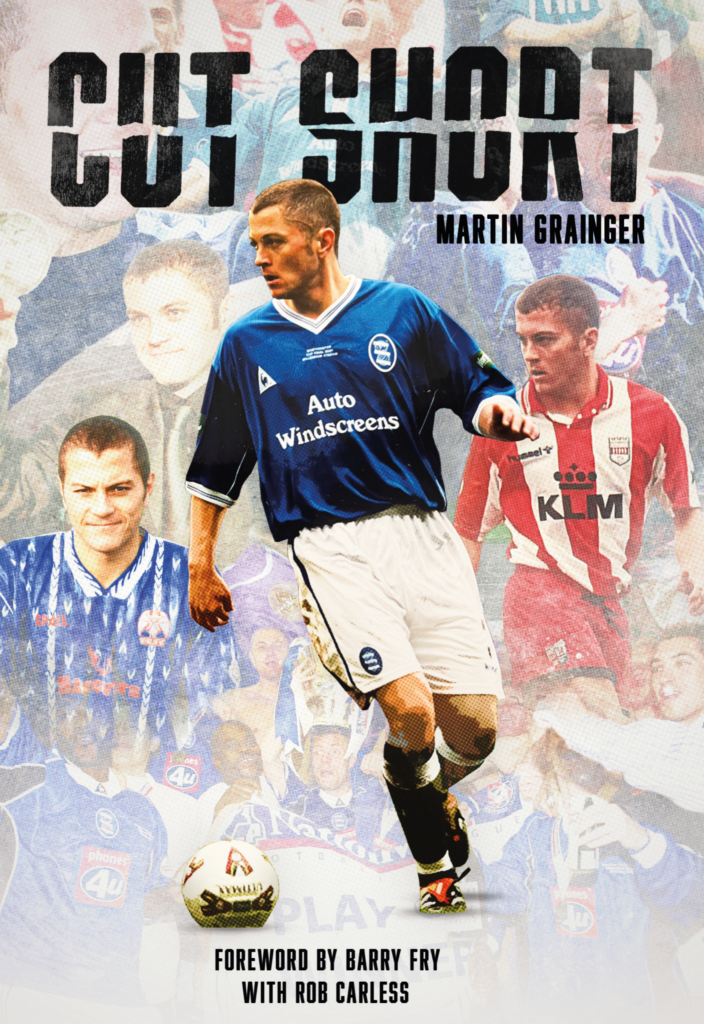
He has laid bare his eventful spell at Blues and football career in a new book, Cut Short, published by Curtis Sport. It can be ordered here.
In a special two-part feature, he chats to Forever Blues’ Colin Tattum, who reported on his days at St. Andrew’s.
Barry Fry saw the potential in Martin Grainger and signed him for Blues in March, 1996.
It was as dream move for the 23-year-old from Enfield. He shirked no challenge and could ping a ball with his left foot with the best of them.
But after just seven games in the royal blue for Grainger, Fry was sacked and the prodigal son – Trevor Francis – returned to take charge.
Blues upped their ambition and flexed financial muscle. Steve Bruce was signed from Manchester United to captain a new era at the club. His addition created a huge stir. Other top, experienced players followed – Gary Ablett, Barry Horne, Mike Newell and a then club record capture, Paul Furlong.
Grainger could be forgiven for thinking his days were already numbered. And that feeling solidified when Francis referred to him in derogatory terms in a passing comment during a match.
“It was a rocky start between us,” recalls Grainger, as Bruce preferred Ablett and then Michael Johnson at left-back initially. He then signed Simon Charlton.
“Trevor brought in more, I would say, household names – about 15 left-backs as well – and I wasn’t in his plans at first, so I had to prove myself to him that I was worthy of the position.
“One of the games, one of the lads was laughing afterwards and came up to me and said Trevor was calling me a pub player!
“I think it was during a stretch of games when I was having a tough time. I think I gave away a penalty, scored an own goal and then got sent-off at Bolton.”
When Blues went to Swindon Town in the February, Grainger was warming-up to come on as substitute for Nicky Forster with six minutes left of a 3-1 defeat. In no uncertain terms, a Blues fan nearby told him not to bother getting stripped.
“I reference it in the book,” says Grainger. “I was thinking ‘is this it, people are down on me, is it all over here?’.”
Grainger decided he’d show that particular critic – who has since reached out on X to him – and also Francis. And he did – he became a fixture for Francis, someone he could trust in a variety of positions as it transpired. And the supporter who dished out the stick? “He gave me the kick up the backside I needed, that bloke at Swindon.”
At the end of the 1998/99 season, Blues finished fourth and lost in the play-off semi-final to Watford. Alex Chamberlain was inspired in the St. Andrew’s second leg, won 1-0 by Blues (1-1 on aggregate). Grainger drilled in Blues second penalty in a 7-6 shoot-out defeat.
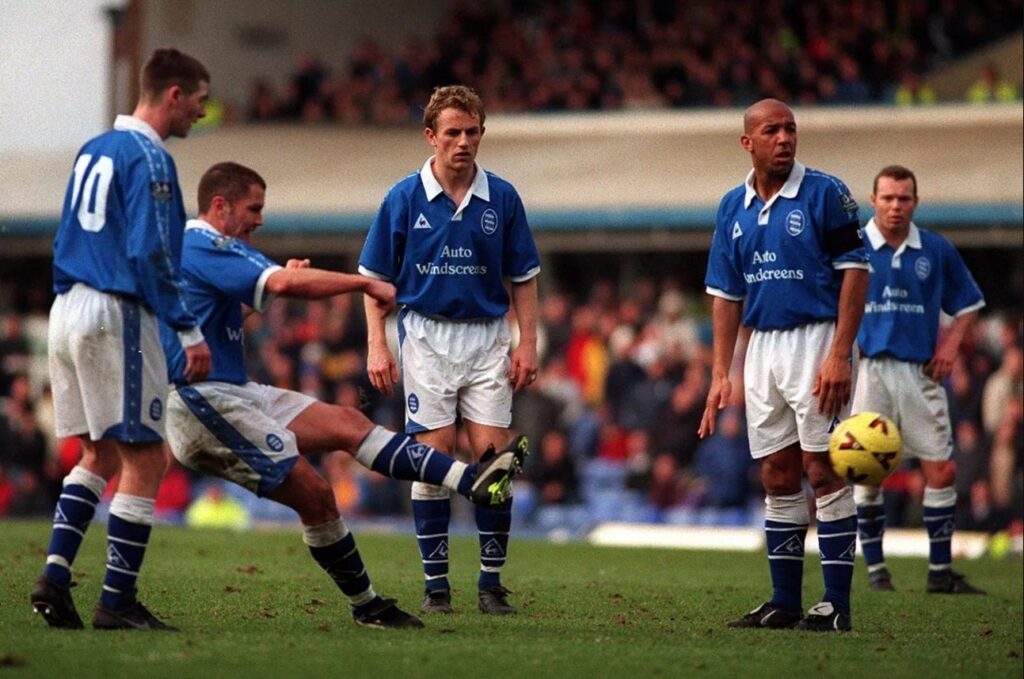
The next campaign, Grainger came into his own. “Played the best football of my career,” he notes. But it wasn’t just at left-back.
“I think I played every position bar in goal. I was right wing for five weeks, up front at Sunderland for the last 10 minutes.
“I was very proud of winning six or seven awards and being voted into the PFA team of the year.”
Grainger was paired in central midfield with Martin O’Connor in the play-off semi-final against Barnsley at St. Andrew’s – which ended in a stunning 4-0 defeat.
“I did my knee in that game, hyperextended it in a tackle. I couldn’t play in the return. In the dressing room afterward, at 4-0, we were like ‘what’s the point of playing the second leg?’.
“They weren’t that good, either. It was a devasting day. Why? It was just one of those things. It can happen. We threw it away.”
That season Grainger made headlines for the right reasons, due to his performances, and also created a huge kerfuffle in the aftermath of a Blues – Wolverhampton Wanderers derby in the April.
To put matters into context, bad blood had been bubbling between the sides, who were both tilting at promotion for a number of seasons.
Wolves manager Mark McGhee casually dismissed Blues as ‘average’ after one game, which ramped up the enmity.
In 1995/96, the teams met four times (Wolves won a third round FA Cup replay) in highly competitive encounters and Kevin Francis had a pop at McGhee.
Grainger took exception to Kevin Muscat’s end of game taunting celebration after a Wolves victory at Molineux in December, 1999 – he chased him down the tunnel and tried to force his way into the home dressing room.
So when the teams met at St. Andrew’s four months later it was a charged affair.
O’Connor was sent-off for lashing out with an elbow on Muscat after the defender dragged his nails down his neck and chest.
There were late tackles on Bryan Hughes – was sent-off for diving (later rescinded) – and Stan Lazaridis, Muscat’s Australian international room mate, was not spared.
Afterwards, Grainger sought me out in the car park, at the steps of the Main Stand reception. He said that Muscat was ‘probably the most hated man in football’, who would get what was coming to him.
I asked him did he really want to say that? The reply was ‘yeah, because it’s true’.
It was a dynamite story for the Birmingham Evening Mail and the comments caused a massive furore, with the PFA even getting involved to try and calm matters.
“Mr Muscat. My mate.
“I am no angel when it comes to tackling on a football pitch.
“But when you tackle someone when it’s 70/30 in your favour and you still go over the top of the ball, I just think that’s ****house. That for me is just not on.
“He’d do that every game. What he did to Stan . . . the stud marks Stan had down his chest . . . he just wasn’t for me.
“I always didn’t play great against Wolves. It was because I was concentrating on giving him one. Probably not the most professional thing to do but that’s just the way he rubbed me up.”
That summer, Graeme Souness’ Blackburn Rovers wanted Grainger. They offered £3 million; Blues demanded £5 million.
“I spoke salary and all that, through agents. It was near on £1 million. Back then it was a lot of money, wasn’t it?
“Trevor was trying to get Christian Poulsen at the time. Birmingham wanted too munch money for me.
“A couple of the lads said ‘refuse to play, put a transfer request in’. I was like ‘if they want me, they want me. If it happens, it happens. I just want to play’.
“In a way I was happy I stayed, in another way I wasn’t happy with the way the club dealt with it. They should have rewarded me with a new contract. They didn’t.”
That was a signpost to how Grainger’s relationship with the regime of David Sullivan, the Gold brothers and Karren Brady deteriorated.
Yet in 2000/01, Blues reached the Worthington Cup Final – a first major final in 45 years – and all was fine on the field.
Grainger nodded in Blues first goal in the semi-final second leg against Ipswich Town at St. Andrew’s, which Blues memorably won 4-1 on an electric night.
“It’s the only time I have ever outpaced a striker,” laughs Grainger. “I got in front of Geoff Horsfield, nodded it in from about an inch.
“I played in two finals at the Millennium Stadium in Cardiff. That night, it was double the volume of those finals. I’ve never been in anything like it.
“To get there, to the final, was a big achievement. We beat Tottenham, Newcastle and Ipswich on the way, three Premier League sides.”
In the final, at the Millennium Stadium against Liverpool, Blues luck was out. It will forever rankle that David Elleray ignored Stephane Henchoz’s lunge that brought down Andrew Johnson in the box in extra-time.
So the trophy was decided on a penalty shoot-out after a 1-1 draw and Grainger, first up for Blues, had his spot-kick saved. Liverpool prevailed, 5-4.
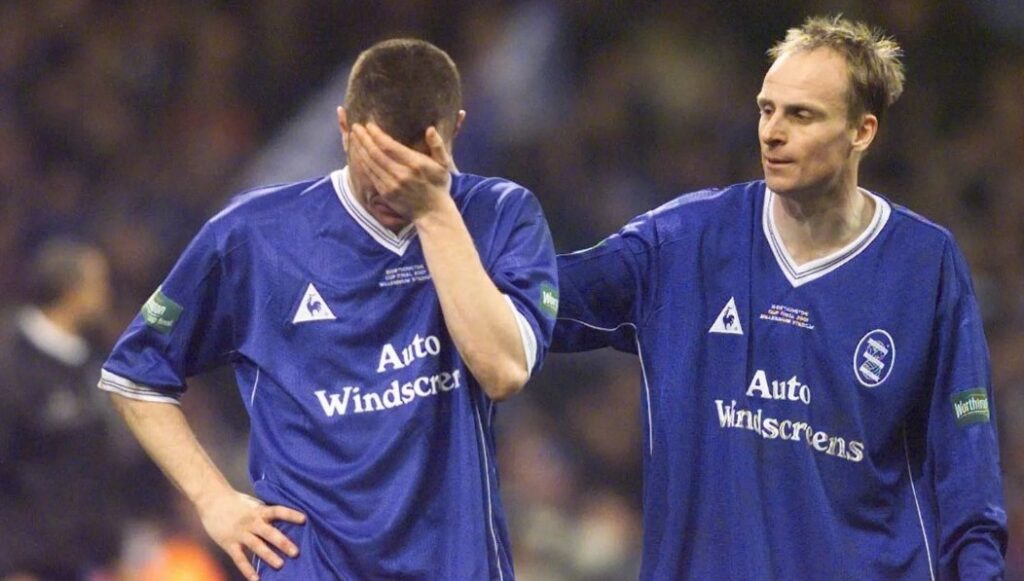
“People were just angry at how it wasn’t given, that foul. We put it down to it being a Premier League referee. But it was just a horrendous decision.
“Everyone forgets my penalty miss because AJ (Andrew Johnson) missed the decisive one.
“I’ve only seen my penalty again once, since. He (Sander Westerveld) stepped off his line by two yards. Narrowed the angle a bit. He guessed correctly.
“It was devastating. You think you’ve let everyone down. You shouldn’t really miss from 12 yards when you have a free shot, but it happens. Although nowadays it would have been retaken as he was off his line.”
Grainger was back in Cardiff 15 months later – as Blues faced Norwich City in the Championship play-off final.
He had to suffer another another semi-final heartache in the second leg of 2000/01 play-offs, however; a defeat by Preston North End (again, on penalties).
But it all came good in the end for Grainger and Blues. He was front and centre for Bruce’s side, after the ex-Blues captain had replaced Francis in December, 2001.
In part two of our exclusive feature, Martin Grainger talks about reaching the promised land of the Premier League, and then how it went sour at Blues.